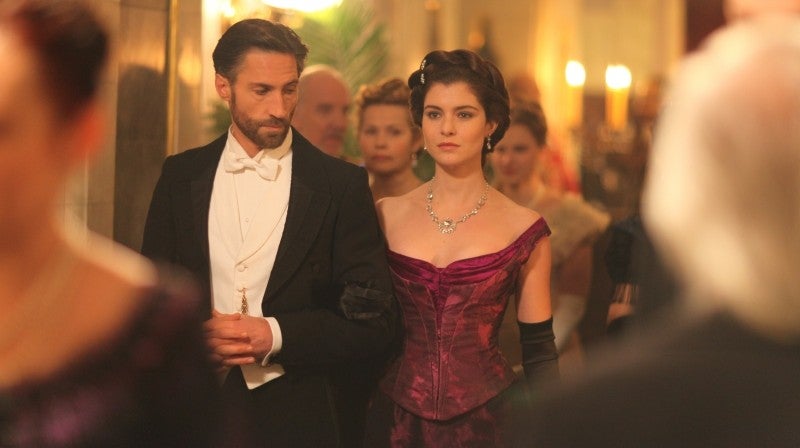
Anna Karenina 2013 Mini Series
ModFilm adaptations of Anna Karenina has a similarity to Jane Eyre adaptations: Too many.I'm aware that there are at least 10 versions on this novel so which is the best? I think the most famous and critically acclaimed version out there is the one starring Greta Garbo in 1930's which I've not seen.I've watched 1997 film, (filmed on location in Russia), starring Sophie Marceau and Sean Bean. I thought it was really good, the characters had such a great chemistry and it worked really well for a shorter version but I thought perhaps Sophie Marceau looks bit too young for the character.Then I watched the 2000 British television adaptation of Tolstoy's Anna Karenina, which I thought ok.
Agewise Helen McCrory is suitable for the role than Sophie Marceau but it was long but not so good. But I liked Kitty and Karenin.Then I learned there will be another version starring Keira Knightley as Anna Karenina!!??? Check it out.So share your favourite version and tell us what you think about this latest one. ModThough there is no mention of her age in the novel, I consider her to be in her late 20's, around 27 or 28. Just a personal calculation with the marriageable age of the period and her son's age. Keira looks too young and I don't know whether she can handle such a mature character.
I liked her in Atonement but she didn't impress me with any other role, just a personal opinion.Now that you mentioned it, does the novel ever mention that Karenin is unattractive? He is much older but I don't think he's unattractive. Whatever it is he doesn't seem like a good choice. Mod Morticia wrote: 'Oh dear, Keira doesn't sound like a good choice! Obviously she's more than pretty enough, but surely acting range should carry more weight than good looks with this role.
(and she was toe-curlin.' I have no idea there was a Doctor Zhivago version out there with her. It's that bad huh?
I've seen 1960's starring Omar Sharif. I really started to dislike Keira after 'Pride and Prejudice.' Morticia check the link in massage 1. According to that Vronsky will be Aaron Johnson, but I'm not familiar with his work, I've not heard anything actually. Amalie wrote: 'Morticia wrote: 'Oh dear, Keira doesn't sound like a good choice! Obviously she's more than pretty enough, but surely acting range should carry more weight than good looks with this role. Hey Amalie:) I've read this week that actor Matthew Macfadyen (Mr.
Darcy in Keira Knightley's version of Pride and Prejudice) has joined cast of new A. Karenina in the role of Oblonsky. I've also read somewhere that they were in talks with James McAvoy to perform Levin, but I don't know if it's official. Aaron Johnson performed starring roles in 'Kick-Ass' and 'Nowhere Boy' (bein a young John Lennon) I watched both and thought he was a fine actor, but I agree he's too young for the idea I had of Vronsky while reading.For the other members, I used to moderate here but for personal reasons I had to quit and limit my time in internet, for those I could cause any doubt regarding the group, my apologies and thanks to Amalie for making it such a wonderful group.
Amalie, thanks for your reply. Sorry I missed the reference to Aaron Johnson - I don't know anything about him either; if he's a young actor as Antia suggests, he might be a bit hard to swallow as Vronsky. I've always imagined Anna and Vronsky to be around their late 30s!I think the Dr Zhivago version I saw was a British television production - it was pretty awful generally and was panned by the critics. I really enjoyed the older film version, even though it might not have entirely caught the spirit of the book. And I just loved Julie Christie as Lara - which is probably one of the reasons I couldn't take to Keira Knightley.Best wishesMary (NB that's my real name which seems more appropriate for discussion than Morticia!). Amalie wrote: 'Though there is no mention of her age in the novel, I consider her to be in her late 20's, around 27 or 28. Just a personal calculation with the marriageable age of the period and her son's age.
I have gotten the impression that the women in Russia fiction of this era married fairly young (late teens)and married older men. Karenina would like be, as suggested, in her mid-20's. For the record Keira Knightley is 26.When deciding which film is best, I believe you have to first determine what is 'best'. The best film based on the story, the most faithful to the original, etc.The 1935 version with Greta Garbo is the most critically acclaimed. She also did an earlier silent version. The 2000 Masterpiece TV version also well.
TV miniseries sometimes have an advantage in that they can explore the story in more depth and are not limited to the typical 100 minutes or so of cinema versions. The star of the Masterpiece version, Helen McCrory, was 32 when the film was released. And Garbo was 30. I don't think any of these mentioned actresses are either too young or too old (sounds like Gogol's Chichikov), it depends on their skill as actresses and our personal preconception of what Karenina looks like. Robert wrote: 'I have gotten the impression that the women in Russia fiction of this era married fairly young (late teens)and married older men. Karenina would like be, as suggested, in her mid-20's.
For the record Keira Knightley is 26.' I've not seen Greta Garbo's version. I've heard it's good. Have you seen it?I think what most of consider is true to the novel and great performing, at least that was what I was considering. As for the age, the correct age is a part of a great production, don't you think, so then Keira's age is more suitable but Robert do you personally think Keira Knightley is good enough to be a good Anna? An earlier comment asked, what makes the movie good?
Does it follow the novel closely or do we just accept that it will borrow a sliver from the story and adapt it for entertainment's sake. Is the acting compelling in telling the story, the script?With new permutation about to hit the theaters,we need to ask how it stands up against earlier versions. In the interest of giving fair judgement I have begun to watch all that I can get my hands on. And here is my take so far.The films so far focus on Anna, Karenin and Vronsky. All the other story lines almost disappear except in how they relate to Anna's story.Greta Garbo was quite good, as was Frederick March as Vronsky. The filming locations had a Russian feel to them although I am sure most were done on back lots.
Garbo seemed to bring a lot of passion to the role -you felt Dolly's children really like her, and Kitty, too.Vivian Leigh seemed to lack the fire that Garbo exhibited. This was a pleasant film with a few different twists not seen in the earlier version and the screenplay was written by Jean Anouil, no slouch. A little more of Kitty and Levin, but still just background to Karenina's story.I've got another one coming tomorrow. I believe it's the one shown on PBS.
Since it's four hours long, one would hope it gives a little more time for other elements of the story. Remember there is a whole lot of book left after Anna kills herself, so Anna's exit is not the end of the story as far as Tolstoy is concerned.I've yet to watch the 1967 Russian production -only the first 28 minutes. The early part of the film is almost an exact duplicate of the Leigh film except the sets are on location and it's in color. The lead is more convincingly passionate than Leigh. I'll watch the balance when I can.A little about the new Anna Karenina:Knightley is just about the right age -mid to late twenties. Maybe too pretty in a modern sort of way. I think Tolstoy says she 'is portly and moves lightly on her feet'.
None of the cinema Annas have been what I consider portly! The New Yorker was not overly generous about the film for what that's worth. We'll see what the Oscar's think. And speaking of age, Jude Law could be exactly the right age to be Karenin, he'll be 40 the end of this month. Forty-year old people were a lot closer to the end of their lives in the 19th Century than they are today. I hope it's good as they spent a lot of money making it.
I've seen the PBS version and also read the book. I read the book and then watched the movie. I really think the movie is kinda of better. Though it misses out on allot of stuff. I knew Knightly was making the movie over a year ago and I wanted to see the trailer before I made a decision of either rethinking about get back into the depressed stage of the full book for me.
I have seen the trailer I'm impressed but then I dont think I could watch another remake of this movie after the last one. I've seen the black and white version and pbs and another company remake it. My favorite Knightly film and book is Doctor Dajavgo.Which was played on masterpiece theatre in the last 90's. All English versions are BAD.
I hate them and I can stand them. Because to really bring the story forth the actors must go through culture training if they don't the story falls flat, and same goes with the director, if the director does not understand Russian culture of that time the story falls flat.
And do not see the new one it really bad I even give you my review on the new one starring Keria Knightly. Watch the one that was made in Russia, by Russians and have Russians actors.
Watch the 1967 version that is found on Amazon the picture might not be that great, but my god it is one of the best versions.DO NOT WASTE YOUR MONEY ON THE NEW VERSION:So I just watched the movie Anna Karenina, starring Keria Knightly and I got to say this movie was over dramatize, stylist, artistic piece of poop! I have seen some pretty bad movies of Leo Tolstoy's Anna Karenina, but this was the worst! Most of the cast was English! The English are not very good at playing people from other countries or culture and this turned a very Russian story to very English one.
Only the Russian people that were the extras in the background spoke Russian.None of the actors went through culture training, because it made the story flat and strange. I would prefer this movie be played by Russian actors.
Actor's mannerism just made it strange. None of the actors had Russian accents, so like any other movie played in Europe, European people speak with English accent.Another thing, this movie was totally confusing and not clear, and one of the reasons why the movie was confusing beyond confusing, was it was too artistic, don't know why the director wanted to make this film artistic and beautiful, but it did no good for the story.
Another thing that cause the movie to be confusing was:First when you begin to watch this movie, you think 'oh going to be theatrical' Then it shifts into Belle. There are many scenes that set on the stage, but then it moves off stage goes into more film like structure. For example: Anna's lover enters a horse race, the horse race is on stage and the on-lookers are the audience and as the race begins the horse falls off stage. Which did NOTHING for the movie! It was like going to play and the actors on stage can't make up their minds if they are speaking to you or their scene partner. There was a lot of back and forth.Relationships in the story were not developed. You did not know that Anna fell in love with this other man, until the character told you they were in love.
Or Kitty fall in love with Anna's lover. So you are sitting there wondering 'Oh, you two love each other?'
And the love scene did nothing for the story, it was more of up close dance of moving your hands this way and that way with Anna moaning over again 'Murdering'. If you want to turn on your lover, I guess saying murdering gets them pretty hot and heavy. Then there was one scene where I thought it was going to turn into up close porno.
No seriously! Anna is outside with her lover and she straddles him and the camera moves closely on some French kissing. All these dumb things did not help the movie!Acting was ok, I was sorely disappointed in Knightly's performance, because she did so good in A Dangerous Method, but her acting was ok. And there were scenes where I just wanted to feed her a burger, because in some, she looked like she was going to snap or break and there nothing appealing seeing someone's bones on their back and in one scene she looked like she had 16 inch waist. She could have done better in her dance scene, she seem not smooth and not graceful, when the people in the background move better than you and they are not the lead there is a problem.Now, Jude Law did a great job in the movie, he connected and even though he had an English accent he acted more Russian than a lot of the other actors, because he understood what he was talking about and connected. And his part made more sense than other thing that was going on this film.Anna's lover in this movie annoyed the hell out of me, he was over the top flamboyant in his movements, everything he did had a feminine flare, he looked like woman with a mustache.
Everything he did from lighting a cigarette had to look beautiful and every time he took off his coat he had to spin around before taking it off. I just wanted to slap him.Every day people do not act like this, certainly not Russians back in Imperial Russia! It made the movie hard to understand!And I really hate to say this too, knowing my Russian history, all the rich people were so elegant looking and there clothes look like it cost an arm and leg and I couldn't help wondering how many Russians were staving outside in the fidget cold, so the rich people can look all pretty with their stupid parties. And some of the costumes did not fit with the time.Anna really annoy me in this film, wonder if she really like this in the book. She falls in love with another man, her husband finds out, tells her she can't do what she doing, she doesn't stop, when her husband shuns her and she has her lover's baby, I guess she dying in bed and she begs for her husband's forgiveness. Her husband finally forgives her, then in second she is cruel to him. You would think once she had her lover and in the middle of getting divorce she would be happy?
She wants to go out and see a play, and her lover is concern how people will think and say, she tells him 'I don't care. Well, it bites her in the ass and the people ostracize her and she feels horrible. Later she burst into tears and says to her lover 'If you really did love me, you wouldn't let me go!' This woman has issues with a capital I. One moment she is happy and in the next totally sad and upset She kills herself at the end by throwing her self on the tracks of an upcoming train. Best thing in the film!
If you are so miserable with yourself, you should do the whole world a favor just throw yourself off a cliff! When she throws herself onto the tracks she says 'forgive me!' This woman cause her own misery.Only thing the movie got right, is showing how many rich Russians live a screw up lives and how many did what Tolstov did and live out in the country to have a more simple life.This movie would have been a lot better, if the actors went through culture training, if the movie was just simple.
But this movie sucks. When doing Tolstoy do not think you can do a better story than him. If you are going to Tolstoy do it right. Or you just ruin a great story. Janith wrote: 'the best way to figure it our is looking at IMDB ratings on each version.Anna Karenina (2012) - 6.6/10Anna Karenina (1997) - 6.4/10Anna Karenina (1948) - 6.7/10Anna Karenina (1967) - 7.2/10Anna Karenina T.V movie(1985) - 6.0/10Hence the winner is.
Anna Karenina - 1967!!' Janith, you didn't mention the British 2000 version starring Helen McCrory, which earned 7.4 on IMDd, so has the highest rating so far.And I can't agree with the comments regarding actors needing cultural training to play Russian roles. You could say that of any role not native, or current to, the actor. What makes a great movie are great actors, directors and writers. I haven't seen the Keira Knightly version, but most of what she does is romantic fluff, same as Jude Law, which is probably fine by the majority of viewers, but if you want a more 'high-brow' version I guess the Russian movie would be best.
Serenay wrote: 'I watched 2013 version and 1997 version and I think 97 version is better. Dont waste your time by watching the new version(2013) of Anna Karenina. Its like a musical and that makes it So boring.' Just be thankful they didn't make a movie out of the musical. Or the opera by Shchedrin.
Or was that a ballet, I can't remember I mean, I wouldn't mind seeing either, but it seems not to be to your taste.As a movie, I liked the new Anna K, though for reasons completely separate from the novel itself. I really enjoyed the way it was 'staged' and shot. Flag AbuseFlagging a post will send it to the Goodreads Customer Care team for review.We take abuse seriously in our discussion boards.Only flag comments that clearly need our attention.As a general rule we do not censor any content on the site.The only content we will consider removing is spam,slanderous attacks on other members,or extremely offensive content (eg.
Pornography, pro-Nazi, child abuse, etc).We will not remove any content for bad language alone, or being criticalof a particular book.
We get a bit more into the depth of the relationship between Anna and Vronsky in this part. We actually get watch it progress. In the meantime, Kitty is heartbroken. Not only did Vronksy not propose, but she is also realizing the mistake she made of declining Levin.
Quite a spot for her to be in, I'm sure.Anna and Vronky's affair becomes physical at this point, as well. I am of the opinion this is all physical and a lust fest for Vronsky. However, Anna wants love and attention from Vronksy she feels she doesn't get from Alexey. She calls him robotic and unemotional several times throughout the book. She can't stand to even look at him.
I feel sorry for her, even though she has put herself in this situation. She wants to be loved and pined for but can't seem to find happiness. Vronsky presses her to run away, but he doesn't understand why that is not an option for Anna because he has not entered parenthood. He can't even fathom what he is asking of her, to leave her one and only son? While he comes across true in his emotions, I still get the feeling that is all a game for him (like Kitty was).
He mentions in part one how he never really wants to settle down. So why go through all of this turmoil?Then Anna reveals everything after the race to Alexey. And i am pretty sure it is downhill from here. Just a guess. But once, the truth is out.there is no turning back.Levin works on his farm and is enjoying the quiet peacefulness of the countryside. His sections seem to be a nice break from all the love affair stuff going on right now. I have to admit I was a bit confused by what had actually happened when I read chapter 11, but later when Anna admitted she was 'with child' it confirmed my suspicions.I got quite annoyed with Kitty in the early parts of this section.

I do not hold much sympathy for the 'broken heart' moping to the point of illness, but I was interested in her change of attitude following the events at the Spa. One thing I did love about War and Peace was the way the characters grew and evolved over the course of the novel. I suspect we will also see some examples of this here. I think that part II gave me better perspective on Kitty and Karenin. Kitty started to evolve into what she ought to be and instead of being submissive to her mother's views of the world, which was what put her through heartache and feelings of shame in the first place, she starts to rebel so slightly and pick her own friends and associates and I am expecting that she'll lead her own way later on.
As for Karenin, he's incapable of showing the slightest gesture of affection even towards his son. He's even unable to react towards the situation he finds himself to be in after he locked all the feelings a person could show right then for the sake of proprieties. There is a part of me that had Sympahty for Karenin in this situation, though. I understood his relationship with Seryozsha to be a reminder of Anna.
When he looks at him, he see her, and therefor has a mixture of emotions, which he does not know how to interpret. He is angry, of course, he is embarrassed, he is jealous (even though he tries not to be) and all of these leads to a feeling of guilt for the way he feels towards his son. It's his own blood and not his fault, Alexey knows this but he is reminded of so much pain when he sees him. I am not condoning any of it, but I believe there is much more under this man's robotic nature.The inner conflict/argument he has with his conscience shows a depth of emotion we have not seen from him up until now. He is so conflicted with how to handle the affair from here.
He is, essentially, over analyzing the situation, although for good reason. He has quite a noble and important position in this aristocratic society, where everything you do or don't do becomes the judgement of others.
He also takes Anna into a lot of consideration too.I feel like his character has so much more depth to it, but the reader is the only one to who sees it. Hopefully he lets more of this inner emotion out/be shown. So, people see him as a human being. It might be because I am further in, but I disagree. While he does not show or communicate any of his emotions, I think society is also to blame for that.
We still live with that to an extent even today. Men are expected, in most high class statues, not to show or communicate their emotions. I think he is a product of keeping to those 'rules' without knowing there is a time when those rules MUST be broken. His situation is one of them. But he does not see it that way. The emotion/real side of him we see is all internal dialogue.
I, honestly, feel sorry for him and have very little sympathy, at this point, for Anna.She made her own bed. I agree with you on that Karenin assumes the masculine role the society back then defined. I also agree with you on that that men-do-not-cry role/duty, however you might call it, still has its effects on the present definition of masculinity. However, he displays no affection toward his wife even before Anna cheated on him. After he realises his wife's infidelity he talks to himself on what he should do to stop her, Anna is his fourth priority among the four main reasons he comes up with.
Anna Karenina Tv Mini Series 2013 Download
That alone shows his lack of emotions for his wife. I think one of the main reasons for this is that he owns Anna, at least that is what he believes in. I don't remember the exact wording, but he thinks over 'disowning' Anna. In other words, Anna is one of his belongings, nothing more. I have almost finished the part three, but I cannot fully sympathise with him even though I understand him.That is why I do not think Anna is only the one to be blamed on this matter.
Can we blame a pet if it scratches us or a hot iron drops over our hands? No, we cannot. Anna is treated as a pet or an iron: something to own. So, it would be unfair to treat her differently.
By no means I claim that she is not guilty. She is, but not as that main one. She is not completely 'black', but 'grey'. I think that is the core thing/idea of this novel: Everything is not only black or white, but they are situated somewhere in between those two. Would she cheat on him if he made it obvious he cared about her? I really don't think so. It isn't his love and respect for Anna that is his first reason to object/attempt to tell her what she does wrong, but his honour.
She realises that and then commits adultery. In other words, she doesn't commit adultery just because she is a serial adulterer, but her husband has already closed emotional doors.One might wonder why she does not get divorced. According to the rules mentioned in the copy I have, only 'innocent' party in a marriage can ask for a divorce.
I am not sure whether lack of emotions in a marriage and its irrevocability can be considered as a good reason for a divorce in a legal point back then. Moreover, Anna would end in misery even if she was the innocent side. There is no legal protection in financial terms in late 19th century. Also, it is not easy to give up a luxurious life. I admit it is hypocrisy at its best to continue living with someone who provides a luxurious but emotionless life and have an affair with someone else. That is the point I criticise Anna.
However, I understand her taking into account the legal rights of women back then. It is not that she does not want to leave that life behind. She does need to be secured a life that might offer less privilege, which is understandable.I also think Anna is more honest than his brother. She can sacrifice her marriage for something she longs for unlike her brother, who wants to eat a cake and have it too. Anil, no one would treat Anna like a pet or an object without her consent in the first place. What did she do to change it in the long 8 years of her marriage?
Out of nowhere, came Vronsky with his bewitching character and she realized that what she had is not what she wanted. Moreover, just because a careless merchant lays out his goods on a pavement doesn't mean that it's a reason for me to steal it. The same applies for Karenin.
He's emotionally disabled, incapable of showing love and affection and focused on business matters and societal appearances. But that's a reason for his woman to step up for herself.The only reason I sympathize with Anna is that her deed is unforgivable for the sole reason that she's a woman of status, for the same deed won't arouse as much tumult in a family if she were a man as in her brother's situation. You would be right that no one could treat Anna as an object if it were 21st century, but what we talk about happens in 19th century. Actually, as you know, even the women in the West gained their rights after the second wave of feminism in 1960s. Therefore, I think it is unfair to judge Anna's actions as if she were a free woman.I think why Anna starts an extramarital relationship is to show that she is not an inanimate object that can be taken in guarantee, but someone who lives and has feelings that needs to be fulfilled. It is indeed a valid question why it has taken so long for her to realise that. It is not that she comes to that realisation.
In fact she has already come to it long before her visit to Moscow to reconcile her brother and his wife. She continues her marriage for her son. She only respects her husband. But that respect ends once she encounters with someone who addresses her basic needs: care and emotions.
Could she leave it at just infatuation without going further? She could, but she is a person, not a model of virtue. In my humble opinion, this is the main topic of the book: there is no single person who is a personification of virtue. Everyone has grey areas, and thus, they should be judged as that.Also, I think your merchant analogy cannot be applied to Karenins' marriage. I haven't married, yet, but witnessed my parents and my friends' marriages and seen that it doesn't work when no love and respect for each other left. That is what happens in Anna Karenina, too. Honestly, I don't think she thinks it through that fully.
She just has a general feeling of unhappiness, someone comes along who has all the right words and charm, something that has faded from early in her marriage (if it ever existed) and she just allows herself to be swept off her feet. She doesn't think it through at all, just enjoys the experience. It's only afterwards, when the consequences are beginning to hit her in the face, that she really begins to think about her place in society and why she's continuing to do this at all. I understand what you are saying Anil, however I do not think her intentions go that deep.
I believe when Anna meets Vronsky at Kitty's ball it's her typical flirting she does with all men. (As we see, throughout the book, this is a part of who Anna is. Her husband complains about it and it is something she continues to do.) The difference with Vronsky is he responds and not in a fun way. He is serious and specific in his actions/reactions to her. I think she does like the attention.
What girl wouldn't even if they are happily married. It becomes something more when she turns into a physical attraction. As soon as we read about the first time she calls her husband ugly in reference, specifically, to his ears, it's downhill from there. This leads me to believe it is about a physical desire for Anna, which goes against a desire to more than an object.
She could have proven that with anybody. Both Anna and Vronsky are captives of the ever so popular deadly sin, lust. It is purely physical. Yes, Anna believes it is love because it is not something she has ever felt around her husband.
But in my honest opinion it is a far cry from love. They both just want the excitement of a physical touch.
The question is what happens when the shine wears off? I agree with you on that it was the attention she received attracted her. However, the narrator tells us that Anna is shown as an example of virtue in Petersburg, which, in turn, vexes other women there. The narrator also tells us that it is perceived as a noble act for a single man to go after a married women for its being an impossible act. (I need a better noun here.) Being shown as a role model and being very attractive, Anna should be the one to be approached by other single men. Yet, she doesn't do anything till she meets Vronsky.
That means either all of men in Petersburg are extremely unattractive-which is impossible-or she isn't approached by others-which is impossible again. In other words, she has not given into lust till she meets Vronsky. Therefore we can conclude that what she feels for Vronsky is much, much stronger than lust even though she is physically attracted to him. I found it very curious that Tolstoy didn't address the intimate act between Anna and Vronsky more directly; sex is an issue he has no trouble describing (albeit by 19th century standards) in The Devil.The subject of religion also stood out to me in this section. Kitty found the succour of Christianity incredibly tempting, and how could one not when:'.
It was a lofty, mysterious religion, bound up with a series of beautiful thoughts and feelings which one could not only believe in because one was told to, but could also love.' In all human griefs consolation is given by faith and love alone and that no griefs are too negligible for Christ's compassion for us.' Kitty turned to God at a time of overwhelming dissatisfaction with her life, and found solace in it.
I think the later revelation of Mme Stahl's unpleasantness is not so much Tolstoy criticising the hypocrisy of religious people, but more than there is no single truth or way to access faith. Kitty's personal spirituality is providing her with comfort, and unlike James above, I don't think that her doing good deeds out of self-interest is necessarily a bad thing.
It's merely her expression of her faith in order to learn to love herself.Sorry, that made no sense.:). I am in the camp that believes that Alexis Karenin really does love Anna but either his upbringing or the ways of the society do not let him show it.
Tolstoy tells us more than once that Alexis was not able to say to Anna what he was thinking but instead talked about how her actions appeared in society. It would seem that he has been trained well on how to behave (perhaps we will find out more about his upbringing later in the story).Anna is lonely and Vronsky is charming and pays attention to her, I think she misinterprets his attention for more than it is. It is hard for me to see Vronsky as really caring for Anna at this point. To me the horse race parallels his feeling towards Anna. It seems a bit like a conquest.
Anil wrote: 'I agree with you on that it was the attention she received attracted her. However, the narrator tells us that Anna is shown as an example of virtue in Petersburg, which, in turn, vexes other women.' Anil, I think you hit it on the head - Anna is for 8 years this example of virtue in an unvirtuous Petersburg society, and you can't tell me other men didn't try.
Vronsky not only turned her head, but made her fully commit a sin by her own standards, something she never considered doing before. A woman like that doesn't go that far with a man just because he doesn't have pointy ears. I think she really loves him, and I think it came out of nowhere for her.All this talk about Alexey, who ever said their marriage was for love anyways? I don't think they ever expected to have real love. We know from Part 1 that her mom arranged her marriage to him as well; I think their marriage is a pretty typical high society 19th c Russian marriage - more for status and income than love.
My impression of Alexey is that he's mostly just insulted that his wife would think of another man and that she might be tarnishing their perfect reputation in town. Or making their marriage 'common'. We know even in her circles there are plenty of other marriages where the wife or husband is cheating, people gossip about it but it's not the end of the world. I think Alexey's upset because he thought he was above that.Has anyone else noticed that Anna's husband and her lover have the same first name?
I can't help but think that's not some coincidental oversight on Tolstoy's part. I keep drawing the parallel that if for some reason Vronsky had decided to get married, he would probably be a pretty similar husband to Alexey - pretty robotic and emotionless, just with expectations for his wife.
I find that interesting. Seeing the affair develop and Anna torn between her life, husband, and child on one side and Vronsky on the other made me think: everyone seems to have two last names (and the convention is still a little lost on me), but Anna seems to always be called by her maiden name, Arkadyevna. It's interesting that the book is not called Anna Arkadyevna, but Anna Karenina, her married name. Is this how Tolstoy defines her true identity? As the married woman, someone who is no longer her own but belongs to her family? Alana wrote: 'Is it called Anna Karenina in the original Russian title?
Or is it that way in the English version because traditionally women have taken their husband's last name, and it would have been confusing.' I looked around online to see what I could find. This is an image of the 1878 publication.

It would be Anna Karenina in it's translation.I would assume readers during that time would have been able to figure out that Arkadyevna was her maiden name. I think it is noted as such in the book. Jessica wrote: 'There is a part of me that had Sympahty for Karenin in this situation, though. I understood his relationship with Seryozsha to be a reminder of Anna. When he looks at him, he see her, and therefor.'
I think Karenin's inner monologue is a strong example of societal developments. He isn't content with simply telling his wife to stop the affair, which seems to be the expectations and role of the man in society. Instead, he wishes for her to see the mistake of it and choose to love him. Although a noble request, I would appreciate a little more aggression on his part. Alex wrote: 'I found it very curious that Tolstoy didn't address the intimate act between Anna and Vronsky more directly; sex is an issue he has no trouble describing (albeit by 19th century standards) in The D.' Someone mentioned in a post above about the role the sex scene really played in the plot that I agree with. I think by downplaying that scene, Tolstoy encourages the reader to instead focus on the resulting consequences of the indiscretion, question why it happened, and the juxtaposition of the developing 'modern' society against the traditional.
Jessica wrote: 'Alana wrote: 'Is it called Anna Karenina in the original Russian title? Or is it that way in the English version because traditionally women have taken their husband's last name, and it would have.' A Russian has three names-his/her given name, his/her patronymic, his/her surname; hence, it is Anna Arkadyevna (daughter of Arkady) Karenina. (Karenin is the masculine form.)Tolstoy doesn't talk about the family to which she was born, so who knows what her maiden name was.BTW, for Tolstoy himself, his full name was Lev Nicholayevich (son of Nicholas) Tolstoy. And there are multiple ways to transliterate into Latin alphabet since Russian is written in Cyrillic.
I'd forgotten she was Stepan's sister. It's easy to lose track of that sort of thing in a Russian novels. Her maiden name would then be Oblonksa. The masculine/feminine of names gets lost in translation, particularly in the American press.Aside from the number of characters with difficult names, the nicknames can create all kinds of problems because the nicknames change spelling depending on the emotion expressed. I found this out when I was writing a Russian character who wasn't very bright. My friend who does Russian linguistics lent me her name book. It's got the proper names, all the nicknames for those names, and the usages for those nicknames.
Of course, the book was printed in Cyrillic, not Latin alphabet, but Boris isn't too different so I figured it out. Bora and Boba (angry nickname). Flag AbuseFlagging a post will send it to the Goodreads Customer Care team for review.We take abuse seriously in our discussion boards.Only flag comments that clearly need our attention.As a general rule we do not censor any content on the site.The only content we will consider removing is spam,slanderous attacks on other members,or extremely offensive content (eg. Pornography, pro-Nazi, child abuse, etc).We will not remove any content for bad language alone, or being criticalof a particular book.