Isadora Keygen
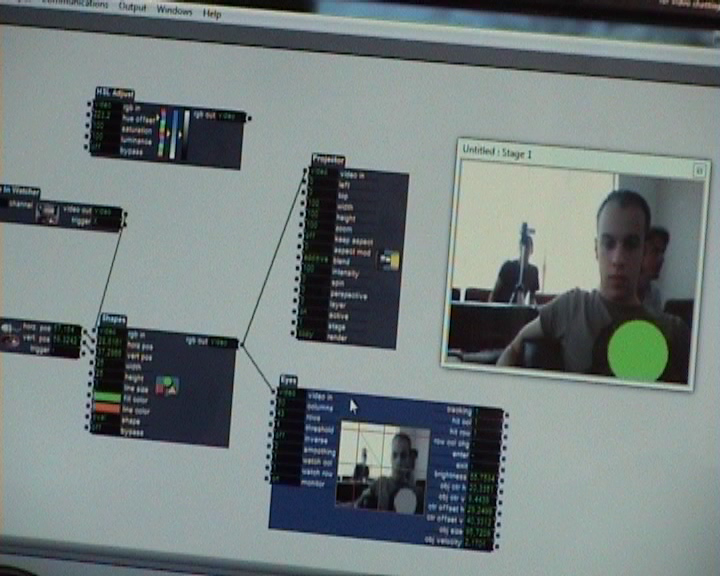
There are multiple methods of creating a presentation, depending on the objectives one has in mind. In general, there are scores of programs to help users in creating detailed business, academic or simple presentations. Isadora, however, seeks to offer a solution to those looking for a tool to create artistic presentations.One can employ this program for music shows, theater or dance performances and, generally speaking, any interactive installation, such as videos for club environments.The application works with several building blocks at the base of which stand multimedia files provided by users. One is free to add audio, video and even graphics documents to the processing queue. Even 3D models are supported and once these elements are in place, various effects can be added.
These bring sparkle to the presentation and come in numerous forms, grouped together in categories.Each effect comes with multiple parameters that can be customized to suit most needs. One of the great features of this program is that it allows working with multiple “Actors” (the name given to effects) in the same scene. With more than 250 such items, and the ability to combine them in whichever way the imagination dictates, users are guaranteed the ability to create unique presentations.One of the really great features of this application is the ability control the parameters of inserted effects in real time, via the mouse or another external device. This can be employed to create artistic presentations that, for example, change transparency or color based on the cursor's position.Summing up, Isadora is special program designed to assist users with a highly developed artistic sense in creating beautiful presentations.
Contents.Early life Isadora Duncan was born in, the youngest of the four children of Joseph Charles Duncan (1819–1898), a banker, and connoisseur of the arts, and Mary Isadora Gray (1849–1922). Her brothers were and; her sister, was also a. Soon after Isadora's birth, her father was exposed to illegal bank dealings, and the family became extremely poor.Her parents divorced when she was an infant, and her mother moved with her family to, where she worked as a seamstress and piano teacher. From ages six to ten, Isadora attended school, but she dropped out, finding it constricting.
As her family was very poor, she and her three siblings earned money by teaching dance to local children.In 1896, Duncan became part of 's theater company in New York, but she soon became disillusioned with the form and craved a different environment with less of a hierarchy. Her father, along with his third wife and their daughter, died in 1898 when the British passenger steamer ran aground off the coast of. Duncan in a Greek-inspired pose and wearing her signature Greek tunic. She took inspiration from the classical Greek arts and combined them with an American athleticism to form a new philosophy of dance, in opposition to the rigidity of traditional ballet.Breaking with convention, Duncan imagined she had traced dance to its roots as a sacred art. She developed from this notion a style of free and natural movements inspired by the classical Greek arts, folk dances, social dances, nature and natural forces as well as an approach to the new American athleticism which included skipping, running, jumping, leaping and tossing. Duncan's philosophy of dance moved away from rigid and towards what she perceived as natural movement.
Isadora Keygen
To restore dance to a high art form instead of merely entertainment, she strove to connect emotions and movement: 'I spent long days and nights in the studio seeking that dance which might be the divine expression of the human spirit through the medium of the body's movement.' She believed dance was meant to encircle all that life had to offer—joy and sadness. Duncan took inspiration from ancient Greece and combined it with an American love of freedom. Her movement was feminine and arose from the deepest feelings in her body. This is exemplified in her revolutionary costume of a white Greek tunic and bare feet. Inspired by Greek forms, her tunics also allowed a freedom of movement that corseted ballet costumes and did not. Costumes were not the only inspiration Duncan took from Greece: she was also inspired by ancient, and utilized some of its forms in her movement (see image).Duncan wrote of American dancing: 'let them come forth with great strides, leaps and bounds, with lifted forehead and far-spread arms, to dance.'
Isadora Keygen 2017
Her focus on natural movement emphasized steps, such as skipping, outside of codified ballet technique. Duncan also cited the sea as an early inspiration for her movement.
Also, she believed movement originated from the, which she thought was the source of all movement. It is this philosophy and new dance technique that garnered Duncan the title of the creator of modern dance.Photo gallery. Photographic studies of Isadora Duncan made in New York by during her visits to America in 1915–1918. Duncan with her children Deirdre and Patrick, in 1913In both professional and private life, Duncan flouted traditional mores and morality. She was and an atheist, and alluded to her during her last United States tour, in 1922–23: she waved a red scarf and bared her breast on stage in, proclaiming, 'This is red!
Duncan bore two children, both out of wedlock. The first, Deirdre Beatrice (born September 24, 1906), by theatre designer, and the second, Patrick Augustus (born May 1, 1910), by, one of the many sons of magnate. Both children drowned in the care of their nanny in 1913 when their runaway car went into the.Following the accident, Duncan spent several months recuperating in with her brother and sister. She then spent several weeks at the seaside resort with the actress. The fact that Duse had just left a relationship with the rebellious and epicene young fueled speculation as to the nature of Duncan and Duse's relationship, but there has never been any indication that the two were involved romantically. Duncan andIn her autobiography, Duncan relates that she begged a young Italian stranger, the sculptor, to sleep with her because she was desperate for another baby.

She became pregnant by him, and gave birth to a son on August 13, 1914; the infant died shortly after birth.In 1921, after the end of the Russian Revolution, Duncan moved to Moscow where she met the acclaimed poet, who was 18 years her junior. On May 2, 1922, they married, and Yesenin accompanied her on a tour of Europe and the United States. However, the marriage was brief, and in May 1923 he left Duncan and returned to Moscow. Two years later, on December 28, 1925, Yesenin was found dead in his room in the in in an apparent suicide.Duncan had a relationship with the poet and playwright, as documented in numerous revealing letters they wrote to each other. In one, Duncan wrote, 'Mercedes, lead me with your little strong hands and I will follow you – to the top of a mountain. To the end of the world. Wherever you wish.'
Later life By the late 1920s, Duncan's performing career had dwindled, and she became as notorious for her financial woes, scandalous love life and all-too-frequent public drunkenness as for her contributions to the arts. She spent her final years moving between Paris and the Mediterranean, running up debts at hotels. She spent short periods in apartments rented on her behalf by a decreasing number of friends and supporters, many of whom attempted to assist her in writing an autobiography. They hoped it might be successful enough to support her. In a reminiscent sketch, wrote how she and, her husband, sat in a Paris cafe watching a somewhat drunk Duncan. He would speak of how memorable it was, but what Zelda recalled was that while all eyes were watching Duncan, Zelda was able to steal the salt and pepper shakers from the table.In his book Isadora, an Intimate Portrait, who met Duncan in the last years of her life, describes her extravagant waywardness. Duncan's My Life was published in 1927.
The Australian composer called Isadora's autobiography a 'life-enriching masterpiece.'