New Deal Works Program
. Emergency Banking Act - March 9: FDR closed all banks as soon as he was inaugurated to stop bank runs. It was enacted at great speed. A special session of Congress passed the bill in seven-and-a-half hours. This Act allowed banks to reopen once examiners found them to be financially secure.
Five thousand banks reopened in the next three days. March 20: The Act cut the pay of government and military employees by 15 percent. It cut government spending by 25 percent. The $1 billion saved went to finance New Deal programs. Beer-Wine Revenue Act - March 22: It legalized the sale of beer and wine and taxed alcohol sales, raising federal revenue.
New Deal Programs Today
The Beer-Wine Revenue Act was followed by the passage of the 21st Amendment, which effectively ended Prohibition. April 5: The program hired 3 million workers over the next 10 years to conserve public land. They planted forests, built flood barriers, and maintained roads and trails. April 20: FDR stopped a run on the precious metal.
He ordered everyone to exchange all gold for dollars. May 12: This program funded a wide variety of jobs in agriculture, the arts, construction, and education. Agricultural Adjustment Act - May 12: This legislation to reduce crops. It doubled crop prices by 1937. It was overturned by Supreme Court in 1936 because it taxed processors but gave funds to farmers.
That was remedied in 1938. May 12: The act provided loans to save farms from foreclosure. Tennessee Valley Authority Act - May 18: The program established a federal corporation that built power stations in the Tennessee Valley, the poorest area in the nation. May 27: It required corporations to provide information to investors before issuing stock. June 5: The government no longer had to repay dollars with gold. June 13: The act established the Home Owners Loan Corporation that refinanced mortgages to prevent foreclosures. It also provided additional capital to mortgage lenders.
New Deal Workers Program
When it closed in 1935, it had refinanced 1 million homes, which was the equivalent of 20 percent of all urban mortgages. June 16: This law separated investment banking from. It prevented retail banks from using depositors' funds for risky investments. It gave the regulation of retail banks to the Federal Reserve, prohibited bank sales of, and created the. The act was repealed in 1999 by the Gramm-Leach-Bliley Act.
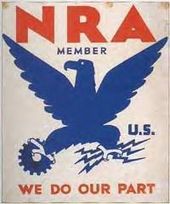
National Industrial Recovery Act - June 16: This labor and consumer law set up the Public Works Administration to create public works jobs, like San Francisco's Golden Gate Bridge and New York City's Triborough Bridge. This law also created the National Recovery Administration. It outlawed child labor, established a minimum wage of $1.25, and limited the workday to eight hours. It gave trade unions the legal right to bargain with employers. It was declared unconstitutional in 1935. June 16: This piece of legislation attempted to coordinate the national railway systems, reduce. January 30: FDR prohibited private gold ownership. He increased the price of gold to $35 per ounce, up from $20.67 per ounce where it had been for 100 years.
That almost doubled the value of the gold held in Fort Knox from $4.033 billion to $7.348 billion, making the United States the world's largest owner of gold. June 27: This law established the Federal Housing Administration, which provides federal insurance for mortgages.
– The law created the Securities and Exchange Commission, which regulates stocks and the stock market. – The Act consolidated all federal regulation of telephone, telegraph, and radio communications under the Federal Communications Commission.

February 29: This program paid farmers to plant soil-building crops, like beans and grasses, to counteract the. April 8: The program replaced FERA and funded the new with $5 million. It employed 8.5 million people to build bridges, roads, public buildings, public parks, and airports. It paid artists to create 2,566 murals and 17,744 pieces of sculpture to decorate the public works. May 20: The law provided loans to farming cooperatives to generate electricity for their rural areas. /Wagner Act - July: This law protected the rights of employees to organize and address working conditions, with or without a union, and created the National Labor Relations Board.
Resettlement Act - May: It created the Resettlement Administration that trained farmers and administered farm debt adjustment activities. It bought 10 million acres of submarginal farmland and paid farmers to convert it to pasture, preserves, or parks. It resettled farmers onto better land and taught them modern conservation and farming techniques.
Social Security Act - August: This law created the and Administration to provide income to the elderly, the blind, the disabled, and children in low-income. The Social Security program provides a guaranteed income for workers who have paid into the system. Most people are familiar with the which can also be extended to the. But Social Security also pays to eligible beneficiaries who become disabled before reaching retirement age.

It pays, surviving spouses, and of eligible beneficiaries who die or become disabled. In some cases, it will even pay benefits to. There is also a program that pays benefits to disabled children and adults with limited income.
There's also a for qualified World War II veterans.
The Great Depression, which lasted from 1929 to 1939, was the largest and most significant economic depression to affect both the United States and all Western countries. The stock market crash on Oct. 29, 1929, is infamously known as Black Tuesday and was the worst stock market decline in the history of the United States. Heavy speculation during the rising economy of the 1920s combined with widespread buying on margin (borrowing a large percentage of the cost of investment) were factors in the crash. It marked the beginning of the Great Depression. To Act or Not to Act.
Roosevelt was elected in 1932, and he had other ideas. He worked to create numerous federal programs through his New Deal to help those who were suffering the most from the Depression. Besides programs built to directly help those affected by the Great Depression, the New Deal included legislation intended to correct the situations that led to the stock market crash of 1929. Two prominent actions were the Glass-Steagall Act of 1933, which created the Federal Deposit Insurance Corporation, and the Securities and Exchange Commission, created in 1934 to be a watchdog over the stock market and police dishonest practices. The SEC is one of the. Here are the top 10 programs of the New Deal. The was designed to combat widespread poverty among senior citizens and to aid the disabled.
The government program, one of the few parts of the New Deal still in existence, provides income to retired wage earners and the disabled who have paid into the program throughout their working lives via a payroll deduction. The program has become one of the most popular government programs ever and is funded by current wage earners and their employers.
The Social Security Act evolved from the Townsend Plan, an effort to establish government-funded pensions for the elderly led.